
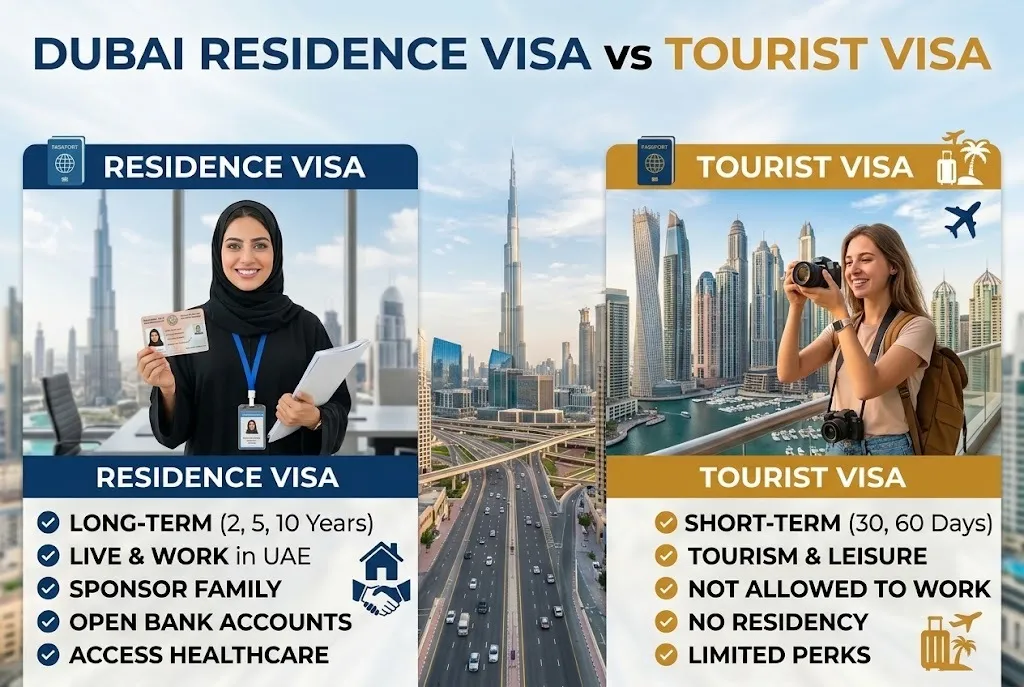
A Dubai tourist visa lets you visit the UAE for a short stay, usually 30 or 60 days, with no right to work. A Dubai residence visa lets you live in the UAE long term, typically for 2 to 10 years, and comes with an Emirates ID, banking access and, depending on the visa type, work rights and family sponsorship.
If you are planning a holiday, a family visit or a move to Dubai, choosing the wrong visa can cost you time and money. This guide compares both visas so you can pick the right one.
Dubai Tourist Visa vs Residence Visa at a Glance
| Feature | Tourist Visa | Residence Visa |
|---|---|---|
| Purpose | Tourism, family visits, short business trips | Living, working, studying or investing in the UAE |
| Typical duration | 30 or 60 days per stay (up to 90 days on some routes) | 2, 5 or 10 years, depending on type |
| Right to work | No | Yes, via employer sponsorship or self-sponsored (Golden, Green) visas |
| Emirates ID | No | Yes |
| Sponsor needed | Usually a licensed tourism establishment; the 5-year visa is self-sponsored | Employer, family member, or self-sponsored |
| Family sponsorship | No | Yes, subject to income and housing rules |
| Issuing bodies | GDRFA Dubai, ICP | ICP, GDRFA Dubai, with MOHRE for work permits |
| Cost | Low, from AED 200 + VAT in government fees | Higher, often AED 3,000–5,000+ for an employment visa package |
| Renewal | Extension possible in most cases | Renewable, with rules on absence from the UAE |
What Is a Dubai Tourist Visa?
A Dubai tourist visa is a short-stay entry permit for leisure travel, family visits and short business trips. It is issued by the General Directorate of Residency and Foreigners Affairs (GDRFA) in Dubai or by the Federal Authority for Identity, Citizenship, Customs and Port Security (ICP). It gives no permission to work and no residency rights.
Types of Dubai Tourist Visas
- 30-day single-entry visa: one entry, one exit, and a stay of up to 30 days.
- 60-day single-entry visa: the same rules with a longer stay, for extended holidays or family visits.
- Multiple-entry visas (30 or 60 days): you can leave and re-enter within the validity period, though each visit is capped at the visa’s duration.
- 5-year multiple-entry tourist visa: a self-sponsored option for frequent visitors that needs no local host. Each visit can last up to 90 days, extendable by another 90, with a maximum of 180 days per year.
Dubai Tourist Visa Fees in 2026
Government fees are published by duration and entry type, before 5% VAT:
- 30-day single entry: AED 200
- 60-day single entry: AED 300
- 30-day multiple entry: AED 300
- 60-day multiple entry: AED 500
- 5-year multiple entry: about AED 3,713 in total, of which AED 3,000 is a refundable security deposit
Because most tourist visas are processed through a licensed tourism company, airline or hotel, the final price you pay includes service charges and varies by provider.
Dubai Tourist Visa Requirements
- A passport valid for at least six months
- A recent passport-size photo
- A copy of your passport
- Extra documents for some nationalities, such as an ID card from your home country
- For the 5-year visa: a bank balance of at least USD 4,000 (or equivalent) held over the previous six months, valid health insurance and a return ticket
Processing usually takes 2 to 4 working days. Citizens of many countries can enter visa-free or get a visa on arrival, but permitted stays vary by passport, so check your nationality’s rules before you fly.
What Is a Dubai Residence Visa?
A Dubai residence visa lets you live in the UAE legally for an extended period. Once approved, you complete a medical fitness test, get an Emirates ID and have your visa stamped. Residents can sign tenancy contracts, open bank accounts, get a driving licence and, in Dubai, must hold valid health insurance.
Main Types of UAE Residence Visas
Employment Visa
The most common route. Your employer sponsors you and arranges a MOHRE work permit, and the visa is usually valid for two years and renewable. Under UAE labour rules, the employer normally covers visa and work permit costs.
Family Visa
Residents who meet minimum salary and housing requirements can sponsor a spouse, children and, in some cases, parents.
Property Investor Visa
Buying property through the Dubai Land Department can qualify you for a renewable 2-year residence visa, with a minimum property value of AED 750,000.
Green Visa
A 5-year self-sponsored visa, introduced in 2022:
- Skilled employees: a minimum salary of AED 15,000 per month plus a bachelor’s degree
- Freelancers: annual income of at least AED 360,000
- Business owners: annual revenue of at least AED 1 million
Green Visa holders get a six-month grace period after expiry, compared with 30 days for standard visas.
Retirement Visa
For people aged 55 and over who own property worth AED 1 million or more, hold AED 1 million in savings, or earn at least AED 20,000 per month.
Golden Visa
The UAE’s flagship long-term residence, usually issued for 10 years and self-sponsored, so it stays valid if you change jobs.
Golden Visa Eligibility Routes
- Real estate investors: property worth AED 2 million or more
- Skilled professionals: a basic monthly salary of AED 30,000 or more, a recognised degree and a valid UAE employment contract
- Entrepreneurs: an approved innovative project (from AED 500,000) or an established SME route
- Specialised talents: such as scientists, doctors and creatives, subject to approval
Golden Visa Property Rule (Updated 2026)
Since a February 2026 change, eligibility depends on the Dubai Land Department valuation reaching AED 2 million. The earlier 50% paid-up requirement was removed, so mortgaged and off-plan properties can qualify once the bank or developer issues the required no-objection certificate.
Other categories include the Blue Visa for environmental contributors, student visas and the 1-year virtual working programme.
Key Differences Between Dubai Residence and Tourist Visas
Duration and Validity
Tourist visas cover weeks or months. Residence visas run for years, from 2 years for employment and property visas to 5 years for Green and 10 years for Golden.
Right to Work
A tourist visa never allows employment. A residence visa allows work, but employment visas tie you to your sponsor. Golden and Green Visa holders can work on a self-sponsored basis.
Sponsorship
Tourist visas are usually sponsored by a licensed tourism establishment, and only the 5-year visa is self-sponsored. Residence visas are sponsored by an employer, a family member or by you.
Cost
Tourist visa government fees start at AED 200 plus VAT. A full employment residence visa package, covering the entry permit, medical test, Emirates ID and stamping, typically runs AED 3,000 to AED 5,000. Family visas cost roughly the same per person. Investor routes require significant capital.
Access to Local Services
Residents get an Emirates ID, which opens the door to bank accounts, tenancy contracts, driving licences and family sponsorship. Tourists have none of these.
Absence Rules
Standard residence visas can lapse if you stay outside the UAE for more than six months, and Green and property visa holders follow a similar 180-day rule. Golden Visa holders have no absence restriction. Tourist visas have their own limits, such as the 180-days-per-year cap on the 5-year visa.
Overstay Risks
Overstaying a tourist visa brings daily fines, commonly AED 50 per day, and can complicate future entry. Extend before your visa expires.
Which Visa Do You Need?
- Holiday or sightseeing: a 30-day tourist visa is enough.
- Longer family visit: choose the 60-day visa, or a multiple-entry option if you plan to leave and return.
- Frequent visitor or remote worker who travels often: the 5-year multiple-entry tourist visa may be more economical than repeated short visas.
- Moving to Dubai for a job: you need an employment residence visa, sponsored by your employer.
- Investing or starting a business: look at the property investor, Golden or Green Visa routes.
Can You Convert a Tourist Visa to a Residence Visa?
Often, yes. If you find a job or qualify through investment while in the UAE, your sponsor or visa provider can apply for a change of status through ICP, usually without leaving the country, subject to eligibility. Many people enter on a tourist visa to job-hunt, but you cannot legally work until your residence visa and work permit are approved.
Common Mistakes to Avoid
- Working on a tourist visa, which is illegal
- Overstaying without extending
- Assuming any visa holder can sponsor family
- Applying with a passport valid for less than six months
- Relying on outdated fee lists, since fees and rules change
Frequently Asked Questions
Can I work in Dubai on a tourist visa?
No. A tourist visa allows leisure and short business visits only. You need a residence visa and a work permit.
How long can I stay in Dubai on a tourist visa?
Standard visas allow 30 or 60 days. The 5-year multiple-entry visa allows up to 90 days per visit, extendable by another 90, with a cap of 180 days per year.
Is a residence visa the same as a Golden Visa?
No. The Golden Visa is one type of residence visa, usually valid for 10 years and self-sponsored. Employment, family, property and Green Visas are also residence visas.
Can I sponsor my family on a tourist visa?
No. Only residence visa holders who meet income and housing requirements can sponsor relatives.
Do I need a residence visa to open a bank account in Dubai?
Most UAE banks require an Emirates ID, which comes with a residence visa. Some banks offer limited non-resident accounts.
Can I extend my Dubai tourist visa?
In most cases, yes, for an additional fee and subject to current rules. Apply before the visa expires.
Get Your Dubai Tourist Visa With Hadaf Al Muteena Tourism
Whether you are visiting for a week or planning a longer stay, we make the tourist visa process simple, from document checks to fast processing and support at every step.