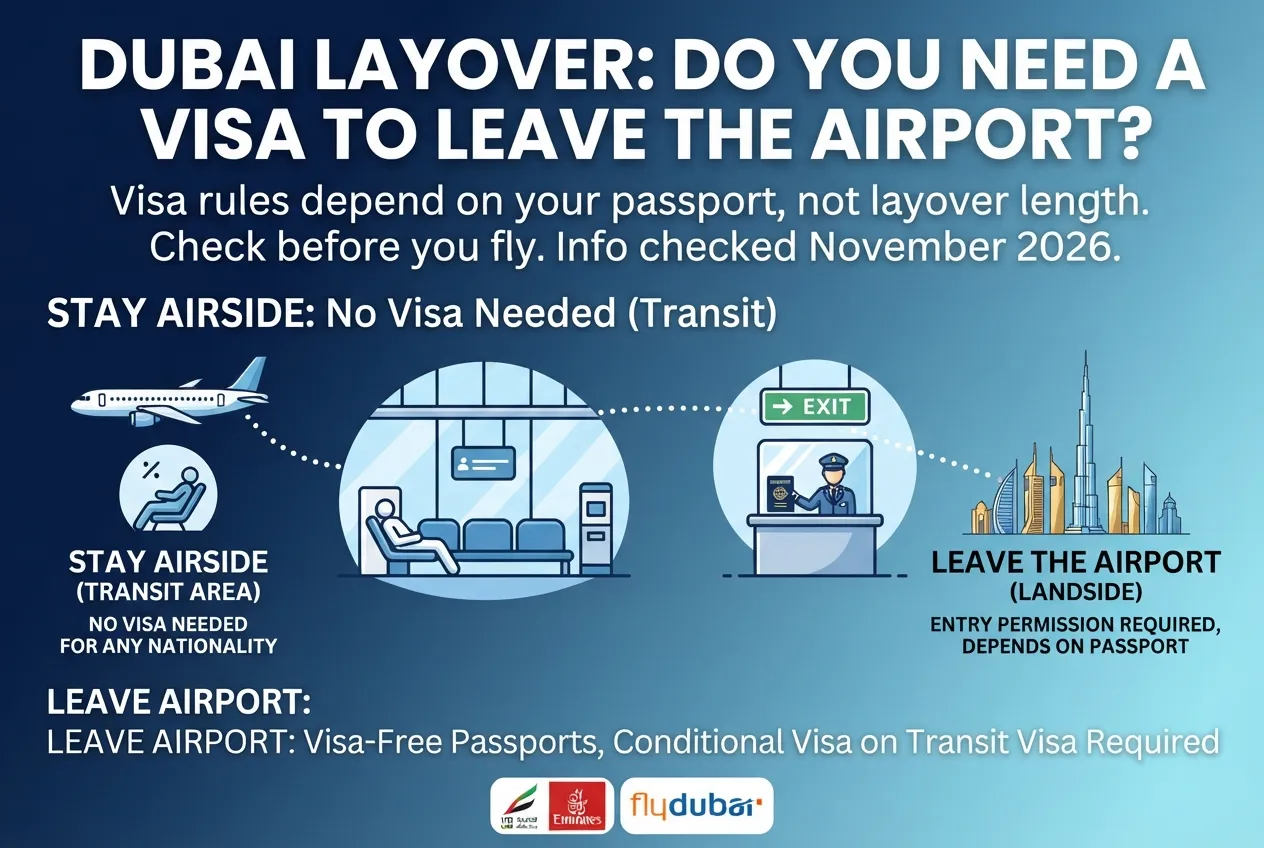
You do not need a visa to stay inside the transit area of Dubai International Airport (DXB), but you do need UAE entry permission to pass passport control and leave the terminal. The permission you need depends on your passport, not on how long your layover is.
- Staying airside: no UAE visa is needed for any nationality, as long as you hold the documents your next country asks for.
- Visa-free passports: holders of passports such as the United States, United Kingdom, Canada, Australia, China, Japan and most EU countries can leave the airport without arranging anything in advance.
- Conditional visa on arrival: passport holders from India, Indonesia, Kenya, the Philippines, South Africa, Thailand and Vietnam qualify only if they hold a valid residence permit from a listed country.
- Every other passport: a 48 hour or 96 hour UAE transit visa, or a tourist visa, must be arranged before you fly.
According to the UAE government portal, the 48 hour transit visa is free of charge and the 96 hour transit visa costs AED 50 (about US$13.60). Both must be approved through a UAE-based airline such as Emirates or flydubai before you enter the country.
These rules were checked against UAE government and airline pages in November 2026. Entry rules change, so confirm them with your airline before you book.
Layover, transit and stopover: what each term means for your visa
A visa becomes relevant the moment you clear passport control, because that is when you formally enter the United Arab Emirates. Until then you are in the international transit area, which is called airside.
| Term | Meaning | Visa effect |
| Layover | A connection between two flights, usually under 24 hours | None while you stay airside |
| Stopover | A longer planned stay, usually over 24 hours, in the connecting city | Entry permission needed, because you will leave the airport |
| Airside (transit area) | The secure zone after security, before passport control | No UAE visa for any nationality |
| Landside | The public side after passport control, including baggage reclaim and arrivals | Visa-free entry, visa on arrival or transit visa needed |
| Passport control | The immigration counters where the UAE admits or refuses entry | Your visa or entry permit is checked here |
| Through-checked baggage | Bags labelled to your final city on one ticket | You do not collect them in Dubai |
Baggage is the detail that catches many travellers out. If both flights are on a single ticket, your bags are normally checked through and you can stay airside. If you booked two separate tickets, you usually have to collect your bags and check in again, which means going landside and clearing immigration even if you never planned to leave the airport.
Your next country’s entry rules still apply while you wait in Dubai. Your airline will check that you hold any visa or travel authorisation your final destination requires before it lets you board in Dubai.
Which passports can leave Dubai airport without a transit visa?
Passport holders from dozens of countries can walk through immigration at DXB without a visa arranged in advance, so a transit visa is only for everyone else. The table follows the June 2026 list published by Khaleej Times.
| Entry category | Permitted stay | Passports covered |
| GCC nationals, no visa | Passport or national ID | Bahrain, Kuwait, Oman, Qatar, Saudi Arabia |
| Visa-free | Up to 90 days within any 180 days | Includes the United States, United Kingdom, Canada, Australia, New Zealand, China, Japan, Singapore, South Korea, Switzerland and most EU member states |
| Visa-free | Up to 30 days | Andorra, Brunei, Hong Kong, Kazakhstan, Macau, Malaysia, Mauritius, Monaco, Mongolia, Republic of Ireland, Ukraine, Uzbekistan, Vatican City |
| Conditional visa on arrival | 14 or 60 days, depending on the category chosen | India, Indonesia, Kenya, Philippines, South Africa, Thailand, Vietnam, only with a valid residence permit from the US, EU, UK, Singapore, Japan, South Korea, Australia, New Zealand or Canada |
| All other passports | Transit visa or tourist visa | Must be arranged before travel |
The article itself notes a mismatch between its headline count of 49 countries in the 90 day group and the longer list it prints, so check your own passport on the official ICP or GDRFA Dubai list before you rely on the table. Visa-free visitors may not work during their stay, and the UAE asks for a passport valid for at least six months from the date of entry.
South African passport holders deserve a specific note. Without a qualifying residence permit from one of the listed countries, a South African passport needs a pre-arranged visa, which for a layover means a 48 hour or 96 hour transit visa or a tourist visa.
48 hour and 96 hour UAE transit visas: validity, fees and conditions
The UAE issues two transit visas, one for 48 hours and one for 96 hours, and the federal Identity, Citizenship, Customs and Port Security authority (ICP) sets the rules for both. The details below come from the UAE government portal and the Emirates visa page.
| Attribute | 48 hour transit visa | 96 hour transit visa |
| Government fee | Free of charge | AED 50 |
| Validity | 48 hours from entry into the UAE | 96 hours from entry into the UAE |
| Minimum passport validity | 3 months | 6 months |
| Extension or renewal | Not possible | Not possible |
| Upgrade | Cannot be upgraded to 96 hours | Not applicable |
| Who issues it | A UAE-based airline | A UAE-based airline |
| Onward booking | Confirmed ticket to a third destination | Confirmed ticket to a third destination |
| Photo | Self-photo on a white background | Self-photo on a white background |
| Use window | Enter within 30 days of issue | Enter within 30 days of issue |
| Emirates listed price, including VAT | US$10 | US$49 |
The fee row needs a careful reading. The AED 50 is the government fee for the 96 hour visa, while airlines and visa agencies list their own totals that cover processing, so always ask for the full price before you pay. Emirates states that its transit visa fees are non-refundable.
The clock starts when you are admitted at passport control, not when you land. A 48 hour visa that is stamped at 10:00 on Monday means you must leave the UAE by 10:00 on Wednesday.
Who issues a Dubai transit visa and what documents you need
Only a UAE-based airline can sponsor a transit visa, and the visa must be approved before you enter the UAE. UAE carriers include Emirates and flydubai in Dubai, plus Etihad and Air Arabia, and a travel agency can help with the paperwork but the application still goes through the airline.
Airline agents submit the application online through the ICP eChannels portal, the UAEICP smart app, or the GDRFA online channels of the relevant emirate. You do not file it yourself on a government site.
Documents for both visa types:
- A passport or travel document valid for at least 3 months (48 hour visa) or 6 months (96 hour visa).
- A recent photo of yourself on a white background.
- A confirmed onward booking to a third destination, which must not be the place you are arriving from.
- A confirmed ticket with a UAE-based airline that includes your Dubai stop.
Emirates adds conditions for its own customers. The booking must be a single confirmed Emirates reservation, every Dubai flight in it must be on Emirates, and the page asks you to apply at least four international working days before arrival. Itineraries that include another carrier on the Dubai flights are not eligible for the online route.
The visa is tied to the airline that sponsored it. An Emirates transit visa is valid for travel on Emirates tickets outbound from Dubai, so you cannot sponsor it with one airline and then leave on another.
How to apply for a Dubai transit visa step by step
The application takes six steps, and the first one decides whether you need to apply at all.
- Check your passport against the visa-free and visa on arrival lists in the section above. If your passport is covered, you can skip the rest.
- Confirm that your ticket is with a UAE-based airline and that your onward flight leaves within 48 or 96 hours of arrival, to a third destination.
- Gather your passport scan, white background photo and ticket details. Check that the passport has 3 months (48 hour visa) or 6 months (96 hour visa) of validity.
- Submit the request through your airline’s manage booking page, or ask a UAE visa agency to submit it for you. A UAE visa agency such as Hadaf Al Muteena Tourism handles the 48 hour and 96 hour transit visa applications on the apply now page.
- Wait for the approval, which the airline sends electronically by email, and carry a printed or saved copy with your passport.
- Show your passport and approval at the DXB immigration counter. Your visa period starts when you are admitted, and you must leave the UAE inside that window.
Apply early. Emirates asks for at least four international working days before arrival, and its own stopover terms ask for documents three working days ahead for 96 hour stays, so a last minute request can leave you airside.
How long a layover do you need to leave Dubai airport?
The visa rules do not set a minimum layover, but passport control, travel time and the return to the terminal set a practical one. The planning guide below is a rule of thumb, not an official rule.
| Layover length | Realistic plan | Visa angle |
| Under 6 hours | Stay airside and use the lounges, shops and restaurants | No visa needed |
| 6 to 10 hours | A short trip to Downtown Dubai, only if you can enter without a visa and queues are short | Visa-free or visa on arrival passports only |
| 10 to 24 hours | Dinner or an evening in the city, or a hotel rest | Visa-free entry, or a 48 hour transit visa |
| 24 to 48 hours | A full day of sightseeing and a night in a hotel | 48 hour transit visa, or visa-free entry |
| 48 to 96 hours | A short city break with day trips to Abu Dhabi or Sharjah | 96 hour transit visa, or visa-free entry |
A sensible rule is to be back at DXB about three hours before your departure, because you need time for passport control, check-in and security. The Dubai Metro Red Line takes roughly 25 minutes from Terminal 3 to Burj Khalifa/Dubai Mall station, so a trip to Downtown Dubai is realistic once you allow for queues at both ends.
Emirates also runs a Dubai Connect programme for eligible passengers on long connections, which bundles a hotel, meals, transfers and the visa where one is required. The layover window and cabin rules depend on your booking, so read the conditions on emirates.com before you assume you qualify.
What to see with the time you have:
- Downtown Dubai: Burj Khalifa, The Dubai Mall and the Dubai Fountain.
- Old Dubai: Al Fahidi Historical District, the Gold Souk and an abra boat ride across Dubai Creek.
- Coast: Jumeirah Beach and the Palm Jumeirah.
- Abu Dhabi: Sheikh Zayed Grand Mosque, a day trip that suits a long layover or a 48 or 96 hour stay.
Dubai airports and terminals: where your layover happens
Dubai International Airport (DXB) is the airport most layovers use, and it handled a record 95.2 million passengers in 2025 according to Gulf News. Dubai Airports also operates Dubai World Central, known as Al Maktoum International (DWC), so check which airport your ticket names.
| Terminal | Main users | Gates | Dubai Metro access |
| Terminal 1 | A wide range of international airlines | D gates | Yes, Red Line |
| Terminal 2 | Selected scheduled, regional and charter services | F gates | No direct Metro link |
| Terminal 3 | Mainly Emirates, plus some other carriers | A, B and C gates | Yes, Red Line |
Terminal 2 is a physically separate building, so a connection that involves it needs extra planning and a larger time buffer. Details on terminals come from a DXB terminal guide, and your airline can confirm how your own transfer works.
Many international connections are completed airside without entering the UAE, so no visa is needed. Entry eligibility only matters when your itinerary forces you through passport control, for instance a self-transfer on separate tickets that requires you to collect and re-check bags.
For a trip into the city, the Dubai Metro Red Line serves Terminal 1 and Terminal 3 stations and reaches Downtown Dubai without a taxi. You need a Nol card to travel on the Metro.
Common Dubai layover visa mistakes to avoid
Most layover visa problems come from timing and ticket rules rather than from the visa itself. These are the mistakes that matter.
- Arriving without approval: the UAE government says a transit visa must be processed and approved before you enter the UAE, so do not plan to collect one at the airport.
- Using the wrong airline: the visa must be sponsored by a UAE-based airline, and an Emirates visa is valid with Emirates tickets outbound from Dubai.
- Booking the wrong onward flight: the onward booking must go to a third destination, not back to the country you came from.
- Short passport validity: the passport needs 3 months for the 48 hour visa and 6 months for the 96 hour visa.
- Expecting an extension: neither visa can be extended or renewed, and a 48 hour visa cannot be upgraded to 96 hours, so choose the right one at the start.
- Applying late: Emirates asks for at least four international working days before arrival.
- Buying separate tickets: two tickets often mean collecting bags and clearing immigration, which turns a simple connection into an entry.
- Overstaying: the visa period runs from the moment you are admitted, so count from your immigration stamp and not from landing.
- Forgetting your next country: your final destination may need its own visa or authorisation, and the airline will check it before boarding.
If an agency or website quotes a price that looks far above the official fees, ask for a breakdown. The government fee is free for 48 hours and AED 50 for 96 hours, and the rest is processing charge.
Dubai layover visa FAQs
Do I need a visa for a layover in Dubai if I stay inside the airport?
No. Passengers who stay in the international transit area do not pass UAE immigration, so no UAE visa is needed for any nationality. You still need whatever your next country requires.
Do I need a visa to leave Dubai airport with a US, UK or EU passport?
No advance visa is needed. Passports from the United States, United Kingdom, Canada, Australia and most EU countries are on the visa-free list for up to 90 days within any 180 days, and the Republic of Ireland is on the 30 day list.
Do South Africans need a visa for a Dubai layover?
Most South African passport holders do. The visa on arrival route applies only if you hold a valid residence permit from a listed country such as the US, UK, EU, Singapore, Japan, South Korea, Australia, New Zealand or Canada. Without one, you need a 48 hour or 96 hour transit visa or a tourist visa arranged before you fly.
How much is a Dubai transit visa?
The government fee is free for the 48 hour visa and AED 50 for the 96 hour visa. Airlines and agencies add their own processing charges, and Emirates lists US$10 and US$49 including VAT for its own customers.
How long is a UAE transit visa valid?
It is valid for 48 or 96 hours from the moment you enter the UAE, and you must use it within 30 days of issue. You must leave the country before the window ends.
Can I extend a Dubai transit visa?
No. Neither transit visa can be extended or renewed, and a 48 hour visa cannot be upgraded to 96 hours.
Can I get a transit visa at Dubai airport when I arrive?
The UAE government says the visa must be processed and approved before you enter the UAE, so you should arrange it in advance through your airline.
Can I apply for a transit visa myself?
Not directly. Only UAE-based airlines can sponsor a transit visa, and travel agencies and visa agents submit the request through the airline.
Does Emirates give a free visa on a long layover?
Emirates runs a Dubai Connect programme for eligible passengers that can include a hotel, meals, transfers and the visa where one is needed. Eligibility depends on your layover length, cabin and booking, so confirm it on emirates.com.
What is the difference between a layover and a stopover in Dubai?
A layover is a connection of usually under 24 hours, while a stopover is a longer planned stay in the connecting city. Both need the same entry permission if you leave the airport.
Plan your Dubai layover with the right visa
You can always stay airside at DXB without a visa, and you can leave the airport freely only if your passport is visa-free or you hold the right entry permission. Check your passport first, confirm your ticket is with a UAE-based airline, and arrange a 48 hour or 96 hour transit visa before you fly if you need one.